Self-Distillation, briefly
Post-Training, KL-Divergence, Self-Distillation, Credit Assignment.
By Cristian Gutiérrez
From "On-Policy Self-Distillation for Large Language Models", Zhao (ICML 2026)
For discrete probability distributions:
For continuous probability distributions:
Notice that it is not a distance per sé:
In the case of On-Policy Distillation, our probability distribution consists of the next tokens probs over all the next token ids over the vocabulary.
Notice how each token in our sequence \([1, N]\) will have a prefix, hence, we will start with the next token 1, then the next token 2 (which is conditioned by the previous prefill)…
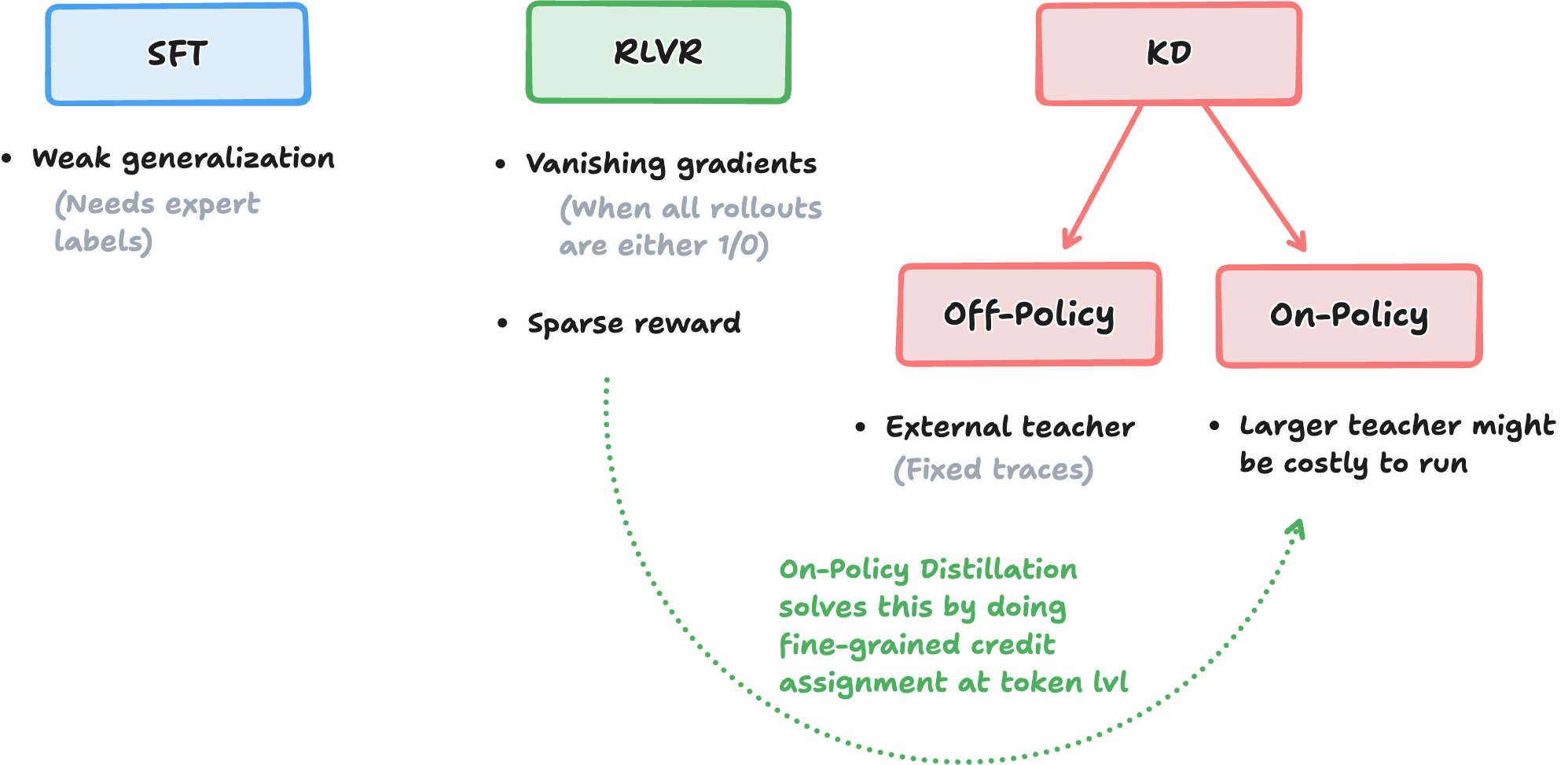
In self-distillation we do on-policy distillation, but using the model itself with extra context (or hints) as target.
Self-Distillation can be modeled as the classical RL of a policy gradient with token-level advantages.
Make \(\pi_\theta(\cdot \mid x)\) match the improved (conditioned) teacher \(\pi_\theta(\cdot \mid x, f)\).
Suppose we have an input prompt asking our student to write a Python function to return all numbers between 1 and n.
The student incorrectly returns \([1, n]\) instead of \([1, n)\).
Then we can condition the teacher, walk the same trajectory and minimize the KL divergence at token-level.
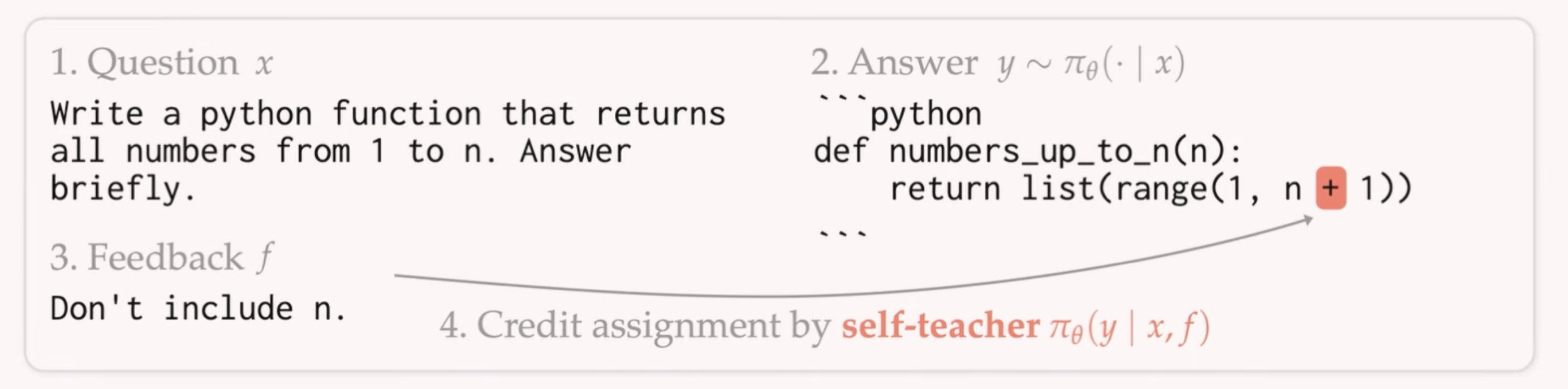
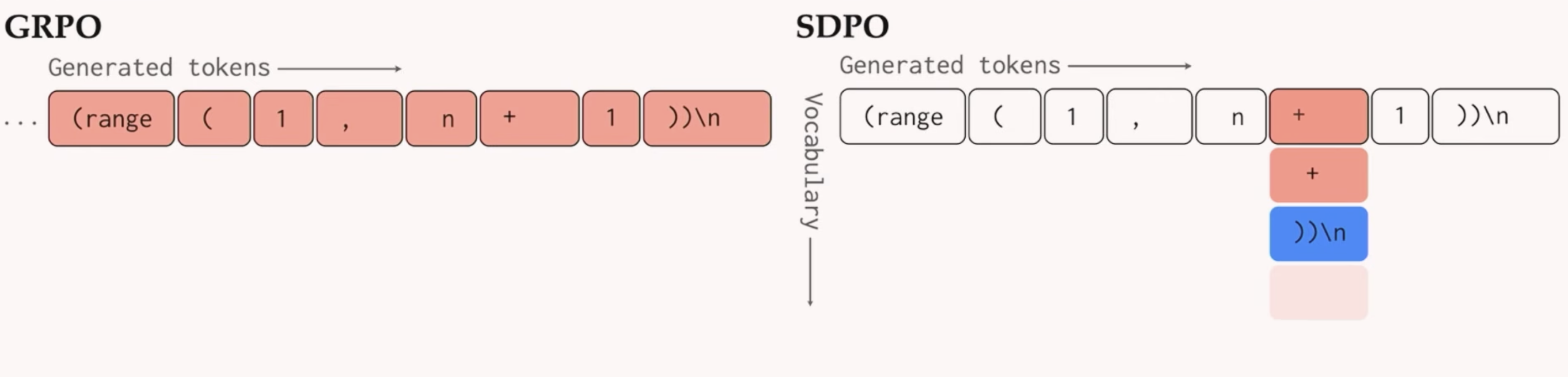
Notice how with distillation, instead of penalizing the whole trajectory (sparse reward problem in RLVR) we would be just penalizing at a more fine-grained level:

And not only that, but we would be penalizing the log-probs of other possible tokens:
References
- Self-Distilled Reasoner: On-Policy Self-Distillation for Large Language Models, Siyan Zhao et al. (2026).
- Reinforcement Learning via Self-Distillation, Jonas Hübotter et al. (2026).
- Self-Distillation: A New Way to Teach and Align AI Models, Andreas Krause, ETH Zürich (talk).
- On-Policy Distillation, Kevin Lu and Thinking Machines Lab (2025).